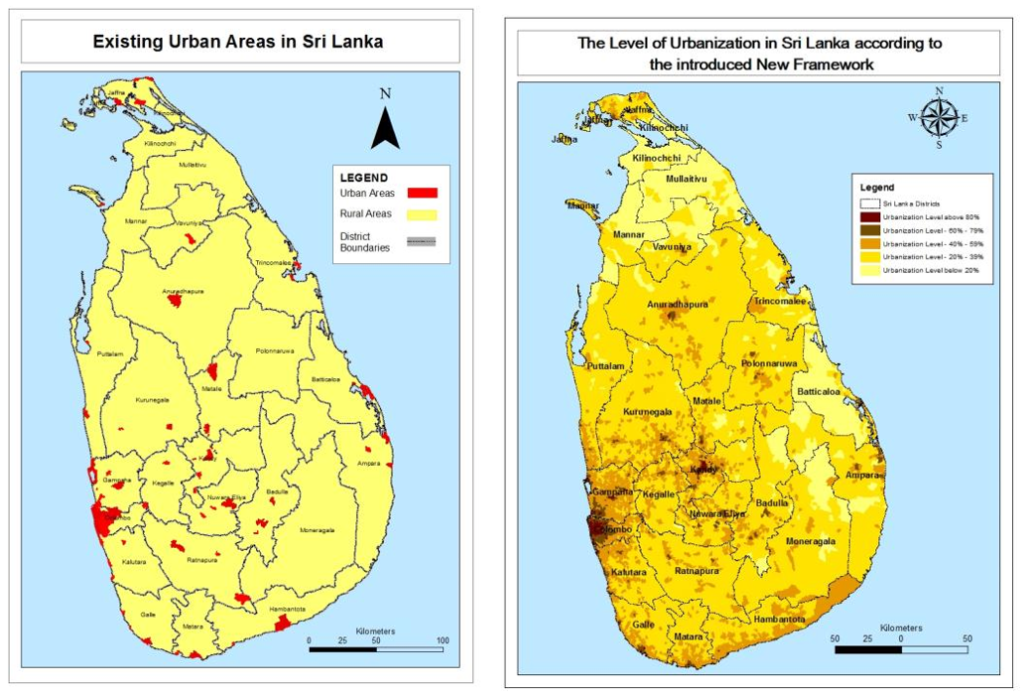
The level of urbanization of a country or a region is generally measured in terms of the share of its urban population. Since there is no universal definition for ‘urban,’ countries follow different approaches, such as demographic, density, administrative, economic, morphological, and functional, to define ‘urban’ in their contexts, and Sri Lanka uses a pure administrative approach. A surprising trend of urbanization was observed in Sri Lanka, with a drop from 21.5% in 1981 to 14.6% in 2001 and 18.2% in 2012. This was recognized as a misleading representation of the urbanization status in Sri Lanka. This research went on to investigate this issue through a comprehensive review of existing definitions of ‘urban’ and respective scholarly works. The initial review of literature had found that definitions of ‘urban’ vary greatly between countries, but usually they comprise several criteria. The research proposes and demonstrates a new definition for ‘urban’ in Sri Lanka by incorporating two core principles, ‘urbanism as a way of life’ and the ‘urban society with urbanization as a spectrum,’ deviating from the conventional dichotomy of urban–rural.
- Impact metrics :
The proposed new definition is adopted in the National Physical Planning Policy for 2050, prepared by the National Physical Planning Department and gazetted in 2019. (incorporated under chapter 02 of the policy document). Further, the same framework is used by the technical advisory committee appointed for the Identification and Declaration of Urban Areas Located in Pradeshiya Sabha Limits in 2021 (the work is ongoing)
- Partnerships
The department works in collaboration with the National Physical Planning Department to incorporate this novel perspective into town and country planning practice in Sri Lanka. Further discussions are held with the Department of Census and Statistics to explore the possibilities of incorporating these for the national definition of urban in Sri Lanka.
- Collaboration Opportunities
- Although the framework is accepted in principle and used to understand urbanization patterns in Sri Lanka, further collaboration is required to scale it into a nationally recognized definition of “urban” for the country. This effort will necessitate broader stakeholder consultations, extending beyond the Ministry of Housing and Urban Development to include other relevant ministries.
- A wider national discourse on the implications of the current definition and the benefits of the proposed framework will only be possible with active collaboration between public and private sector stakeholders. The Department of Town and Country Planning has the technical capacity to implement further improvements as needed.
- Additionally, we are currently in the process of validating the proposed definition using the latest findings from the Population and Housing Census, complemented by field verification. We invite interested parties to collaborate with us on this nationally significant initiative.