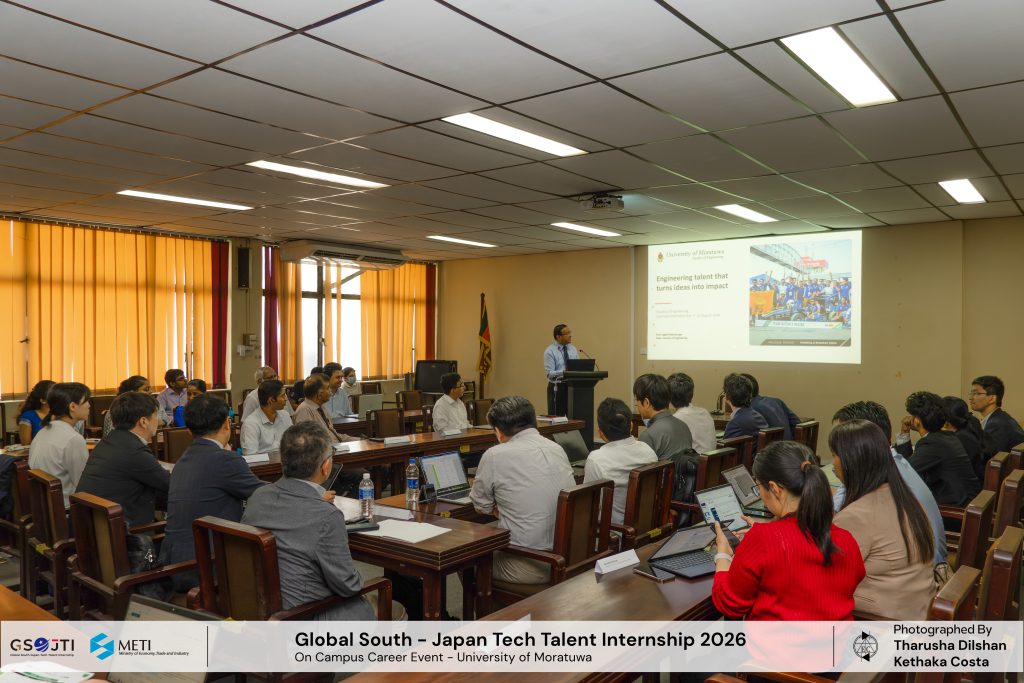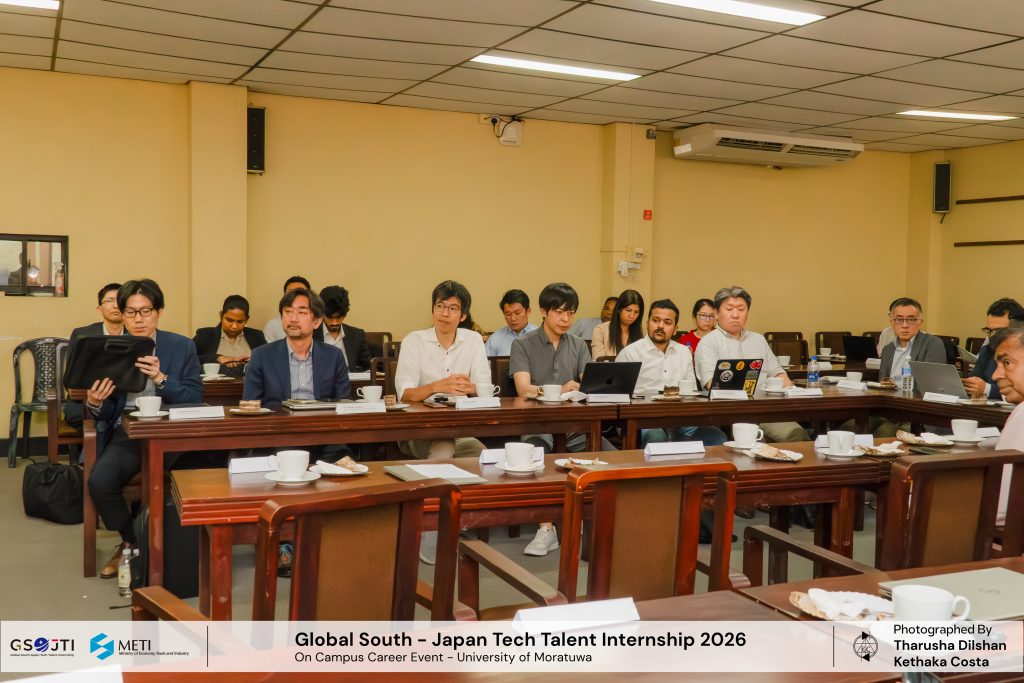
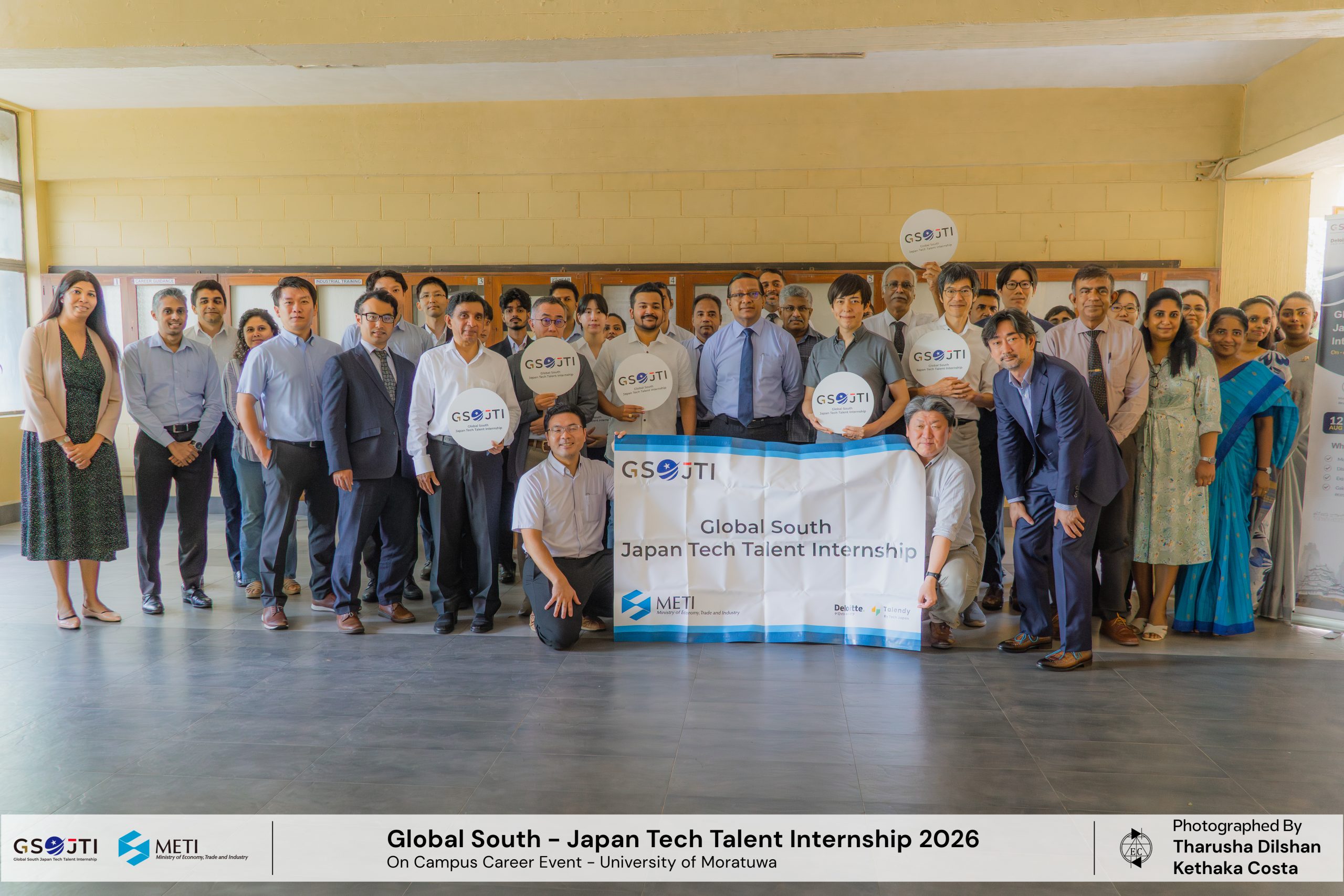
The Enterprise Unit of the University of Moratuwa facilitated a special engagement between the University’s academic community and a visiting delegation from Japan on 12 August 2026, creating a valuable platform to strengthen university–industry linkages and explore international internship and collaboration opportunities for University of Moratuwa students.
The engagement was organised as part of the Global South–Japan Tech Talent Internship (GS-JTI) Programme, which provides opportunities for talented students to gain international industry exposure through internships with Japanese companies. More than 100 Japanese companies have enrolled in the programme to offer internship opportunities, with seven companies visiting the University of Moratuwa as part of the on-site engagement.
The formal session, held at the Faculty of Engineering Board Room, brought together academic staff from the Faculties of Engineering and Information Technology, members of the Japanese delegation and three representatives from the Japan External Trade Organization (JETRO), including the Resident Representative.
As the University’s focal point for strengthening industry engagement and facilitating opportunities that connect academic capabilities with industry requirements, the Enterprise Unit played a key role in coordinating the engagement and bringing together the relevant academic and industry stakeholders.
The session commenced with welcome remarks by the Director/Enterprise, followed by an introduction to the University of Moratuwa by the Dean, Faculty of Engineering. The visiting delegation and the GS-JTI internship programme were subsequently introduced, providing participants with an overview of the programme and the opportunities available for University students.
An interactive discussion and networking session followed, enabling academic staff to engage directly with the Japanese delegation and JETRO representatives. Discussions focused on potential areas for collaboration, internship opportunities and ways of connecting the expertise and capabilities of University students with the requirements of Japanese industries.
A significant feature of the engagement was the Undergraduate Project Showcase, where selected projects from the Faculties of Engineering and Information Technology were presented to the visiting delegation. The showcase enabled the University to demonstrate the technical capabilities, innovation and problem-solving skills of its students and to highlight the breadth of expertise available across different disciplines.
The showcased projects reflected areas relevant to the visiting Japanese companies, including Biomedical Engineering, Computer Science and Engineering, Data Science, Electrical Engineering, Electronics, Information Technology, Mechanical Engineering and Mechatronics. The presentations provided an opportunity to identify potential areas where student capabilities and industry requirements could be aligned, particularly in relation to internships, collaborative projects and future industry engagements.
The engagement also provided academic staff with an opportunity to gain insights into the expectations of Japanese industries and to establish direct professional connections with representatives from the participating companies. Such interactions contribute to the University’s broader efforts to expose students to international industry environments and create pathways for global career and professional development.
The programme concluded with a networking lunch at the TCP Building, allowing academic staff, the Japanese delegation and JETRO representatives to continue discussions in an informal setting and explore potential areas of future engagement.
Through initiatives such as this, the Enterprise Unit continues to support the University of Moratuwa’s efforts to build strong and sustainable university–industry partnerships, facilitate international opportunities for students, and connect the University’s knowledge, innovation and talent with global industry.
The University of Moratuwa looks forward to building upon the relationships established through the GS-JTI engagement and exploring further opportunities with Japanese companies and organisations in the areas of internships, research, innovation, technology development and industry collaboration.